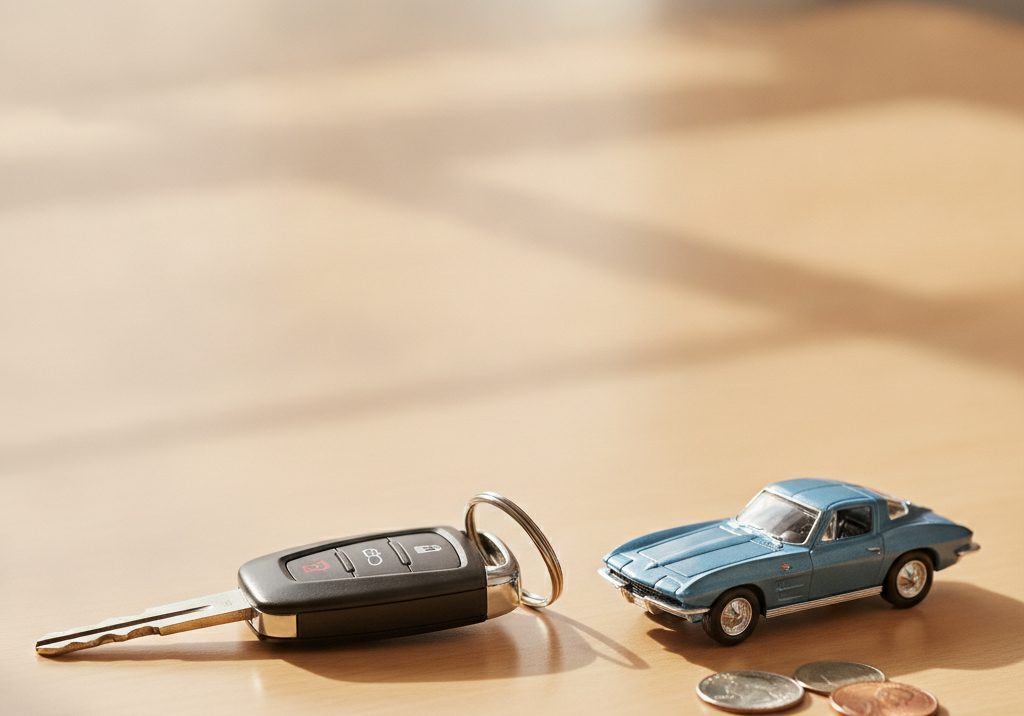
Total cost of ownership: why the sticker is half the story
A $35,000 car does not cost $35,000 to own. Once you add loan interest, fuel, insurance, upkeep, and the value the car loses every year, a vehicle that cost $35,000 to buy can run $57,000 to $62,000 to own over five years, or roughly $950 to $1,030 a month, at 14,000 miles a year on 28 MPG and $3.50 gas. The total cost of ownership calculator adds up all five buckets: interest, fuel, insurance, maintenance, and depreciation, so you see the real number before you sign anything.
Interest is what the lender charges you for the amount financed, computed with the standard amortization formula: monthly payment equals the loan balance times the monthly rate, divided by one minus the discount factor. Fuel scales with your annual miles divided by MPG, times the price of gas. Insurance and maintenance are recurring annual costs that vary by driver and vehicle. Depreciation, the one line item with no invoice attached, is usually the largest of the five and the easiest to ignore because nobody sends you a bill for it.
Loan vs lease decision framing, tied to the site's tools
With a loan, you are paying to own the car outright by the end of the term. With a lease, you are paying for the right to drive it for two or three years, then handing it back, and your payment reflects only the depreciation the car is expected to lose in that window, not its full price. That is why lease payments usually run lower than loan payments on the same vehicle.
The decision comes down to how you use a car. Financing suits people who drive past typical lease mileage caps of 10,000 to 15,000 miles a year, who want to keep a vehicle for a long stretch, or who want equity when the loan is paid off. Leasing suits people who want a new car every few years, who drive predictable and moderate miles, and who would rather have a lower monthly number than an owned asset at the end. Run both scenarios through the auto loan calculator and the car lease calculator before you decide, since the gap between the two payments is easy to see once the numbers are in front of you. For a longer breakdown with a side by side table, see auto loan vs lease.
Depreciation in plain words
A new car typically loses about 20% of its purchase price in the first year alone, then keeps losing roughly 15% to 20% a year after that, landing around 50% of its original value gone by year five. The curve is steep at the start and flattens out over time. The single sharpest drop happens the moment the car is titled and driven off the lot, sometimes called drive off depreciation, which is why a car that costs $35,000 new can be worth closer to $28,000 after twelve months even with no damage and low mileage. This is also why a one to three year old used car is often the better dollar for dollar buy: someone else absorbed the steepest part of the curve. Toyota, Honda, and a handful of trucks tend to hold value better than the average vehicle, so it is worth checking a specific model's resale history before you commit. See the full walkthrough at car depreciation explained or run your own numbers with the car depreciation calculator.